
course
PostgreSQL Querying: Advanced Techniques
Extend your SQL skills with advanced PostgreSQL techniques for real-world data problems.
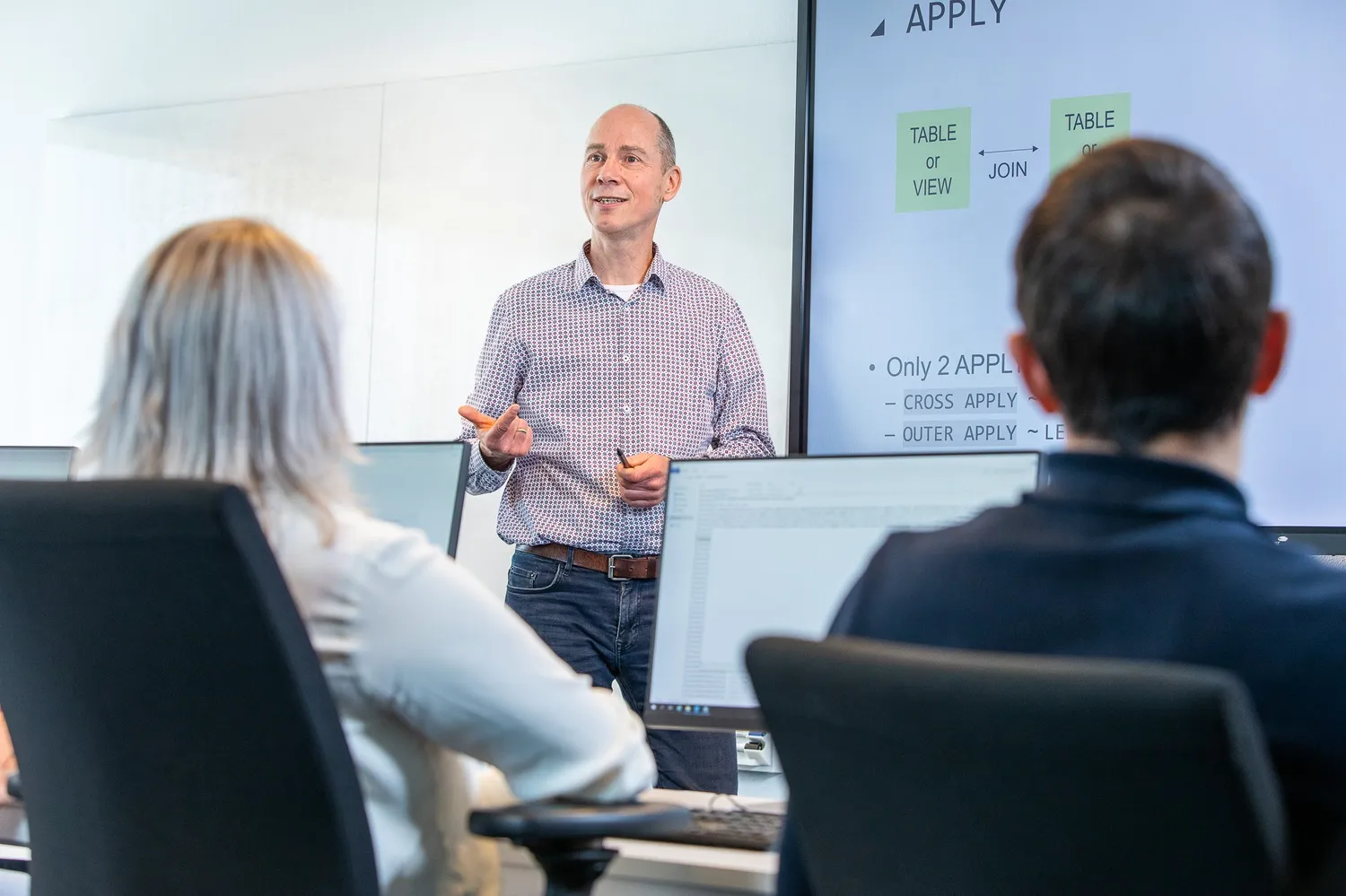
Description
Go beyond SQL basics and learn advanced PostgreSQL querying patterns used in production. You will compare multiple solution strategies, apply window functions, table expressions, and grouping techniques, and choose the best approach for correctness, readability, and performance.
Prior Knowledge
See 'Prior Knowledge Courses' below.
Subjects
- Refresher
- Table Expressions
- Set Operators
- Window Ranking, Offset and Aggregate Functions
- Pivoting and Grouping Sets
- Programming with PL/pgSQL
Refresher
In this module we make sure everyone remembers the basics of querying so we can continue at the same level. Goals:
- Standard elements of a SELECT query
- Joins
- Grouping and Aggregating
- Subqueries
Table Expressions
Table expressions are SQL elements that are not a physical table but can be used as if they were one. Goals:
- Views
- Set-returning Functions
- Derived Tables
- Common Table Expressions (CTE)
- LATERAL joins
- When to pick which option?
Set Operators
Set operators allow you to vertically combine and compare two similar result sets. This contrasts joins, where you combine data horizontally. Goals:
- UNION (ALL)
- EXCEPT / INTERSECT
Window Ranking, Offset and Aggregate Functions
Window functions are ideal for analytics scenarios like running totals and moving averages. They also allow you to look at previous or following values in your result set. Goals:
- Window Functions
- OVER
- Frame
- PARTITION BY
Pivoting and Grouping Sets
Pivoting is often needed to exchange data between different systems. Grouping Sets can help when offering analytic data: in a single query you can cover multiple different aggregations at once. Goals:
- Pivoting with conditional aggregation
- Crosstab (tablefunc)
- GROUPING SETS
- GROUP BY CUBE / ROLLUP
Programming in PL/pgSQL
You can use SQL for querying, but you can also program in PL/pgSQL. Why is this useful in a database, what does the syntax look like, and how do functions and procedures fit in? Goals:
- DO blocks
- Variables
- Functions and Procedures
- Control Flow
- Exceptions and error handling
- Transactions
Schedule
| Start date | Duration | Location | |
|---|---|---|---|
January 7, 2027January 8, 2027 | 2 days | Veenendaal / Remote This is a hybrid training and can be followed remotely. More information Veenendaal / Remote This is a hybrid training and can be followed remotely. More information | Sign up |
All courses can also be conducted within your organization as customized or incompany training.
Our training advisors are happy to help you provide personal advice or find Incompany training within your organization.
Prior knowledge courses
Follow-up courses
"Extremely good teacher"Sander

Hoge waardering

Praktijkgerichte trainingen

Gecertificeerde trainers

Eigen docenten